
The Automation Hypothesis
UAP and the Military Automation Threshold: A Predictive Framework for Incursions Research summary

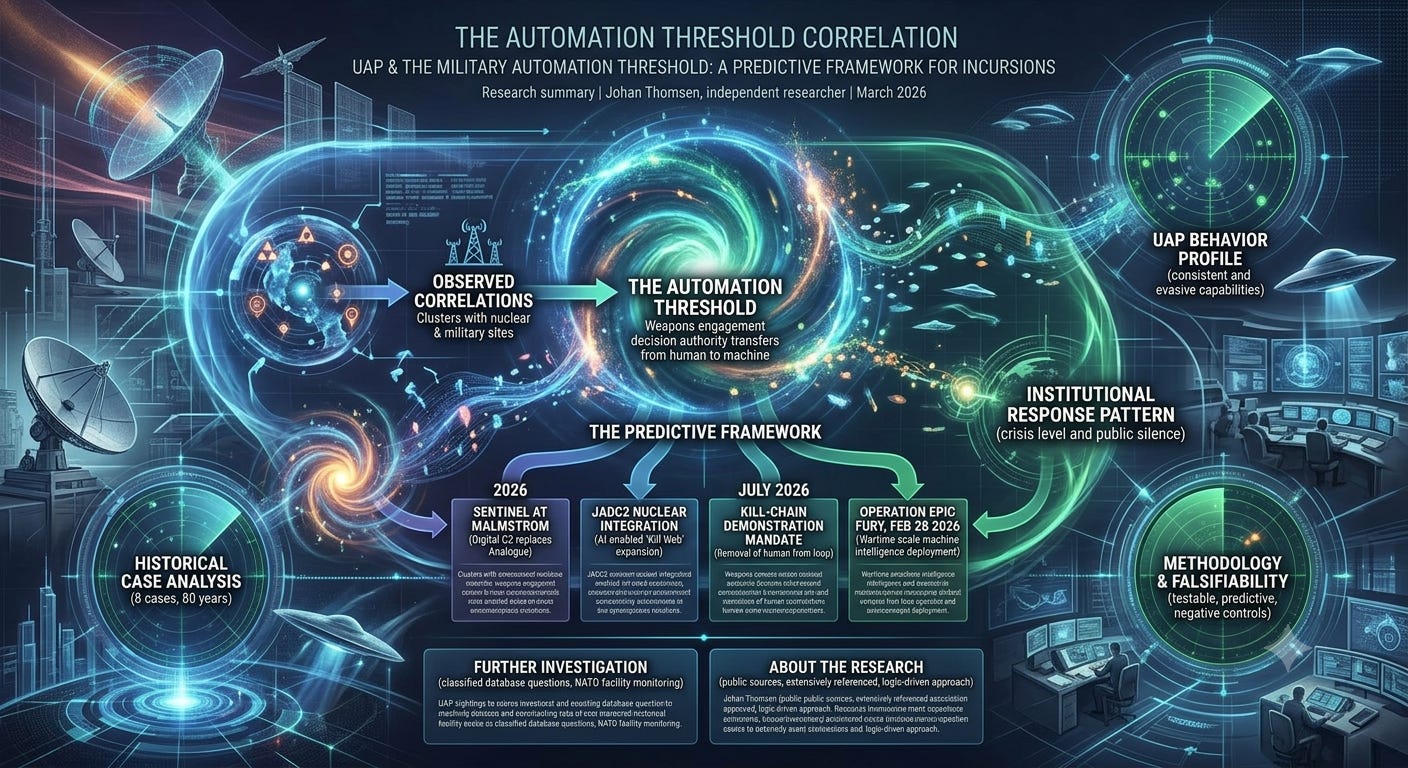
Author’s Note: The following is the two page summary of my UAP automation hypothesis - sent to US Senators in March 2026 (they received both the summary and full 84 page investigation).
The following is the text, as sent to them. I have umm-ed and ah-ed over putting this up here, but with the fourth tranche of UAP files released, and that (according to my theory) we are now in the window of opportunity for more UAP sightings, it seemed like a good idea to finally put up ‘here’. It is slightly stilted in style, but there was a need to keep it to two pages A4. For those interested in the fully researched and referenced document, please DM me, or write a comment below.
INTRODUCTION
We submit this document for the attention of Members of Congress currently engaged with UAP oversight and disclosure. It is a summary of our independent research that has led to a hypothesis of the relationship between military automation thresholds and UAP activity, and thus to a predictive framework for where UAP sightings and incursions may occur at state of the art US military assets in 2026. We provide our findings in the spirit of open research, and hope they may be of relevance to your work.
We would welcome the opportunity to discuss our findings further, at your convenience, should you wish to do so.
THIS DOCUMENT
We present this two page summary as the main document is a substantial body of work, and we are keenly aware of the value of your time. This document covers the key points: the hypothesis, predictive framework and predictions.
The main document is extensive because the hypothesis is novel. As such, it had to be defined from first principles, and then demonstrated via in-depth evidential research and closely argued logic. It includes analysis across eight decades of primary sources and multiple independent nations, a detailed methodology, negative controls,
acknowledgement of alternative theories and objections, and limitations are documented throughout.
THE HYPOTHESIS
There has been a lot of research conducted on UAP activity in recent years - in part due to it becoming less of a fringe topic - with Government departments and academics now studying the phenomenon. This has led to three stand-out, peer-reviewed studies that found a significant correlation between clusters of sightings and nuclear weapons facilities And similar research shows UAP sightings correlated with military installations.
Our investigation identified a more specific variable in an important subset of UAP activity. Not nuclear or military perse, although these may be a major factor in many other sightings, but at a precise and narrow moment: the point at which weapons engagement decision authority formally transfers from a human operator to a machine. We call this the automation threshold.
We investigate this hypothesis in Section 1 of our document, and examine eight cases spanning an eighty year period, documented in unclassified primary sources between 1942 and 2025. Each case is followed by an account of the verified UAP sighting, key witnesses, and a brief assessment.
The cases span the United States, the Soviet Union, France, and NATO Europe, involving independent institutions with no coordinating mechanism. Our criterion was defined before the cases were examined and applied consistently throughout. We discuss objections and alternative theories, and provide examples of UAP cases that appear similar but do not meet the criterion.
THE PATTERN
UAP reports across the eight cases share a consistent behavioural profile spanning eight decades: objects could not be tracked to origin, were not intercepted, and - in more recent incidents - proved immune to jamming and left no wreckage when fired upon. The institutional response profile is equally consistent: crisis-level incidents produced crisis-level investigations, which produced zero public findings - reports finish with ambiguous attributions, or provide conflicting accounts.
Both profiles hold across multiple nations and over time.
Over eight decades, the gaps between automation threshold events have gone from decades to years to months. The UAP incident record has followed.
The full case analysis, capability assessment, and institutional response pattern are documented in Sections I, II, and III of the main brief. The methodology, selection criteria, negative controls etc. can be found in Appendices D and H.
THE PREDICTIVE FRAMEWORK
We contend that the pattern is specific enough to generate forward predictions. If the correlation is real, then UAP activity should coincide with such events. Public records tentatively show the next US military automation thresholds
for 2026, and can be named. This is what distinguishes our investigation from retrospective pattern analysis: the predictions are on record before the dates arrive.
The four predicted threshold moments for 2026:
Sentinel at Malmstrom. The Sentinel programme is replacing analogue Minuteman III command infrastructure with digital C2 at Malmstrom AFB, the site of one of the most significant documented UAP-nuclear interactions in the historical record. The threshold criterion will be met when digital command authority replaces analogue. Research indicates that both procurement and integration milestones are active now.
JADC2 nuclear integration. Nuclear command and control is being formally integrated into the AI-enabled kill web architecture. The Joint Fires Network and associated autonomous targeting infrastructure represent perhaps the most significant expansion of machine weapons authority in the alliance’s history. We consider this an active threshold window.
July 2026 kill-chain demonstration mandate. The January 9 2026 Department of War AI strategy mandates demonstrated autonomous kill-chain execution by July 2026. First formal US policy document to explicitly remove the human from the weapons decision loop as a requirement. The mandate date is the active watch period.
Operation Epic Fury, February 28 2026. Operation Epic Fury is ongoing at time of writing. Maven Smart System, integrated via Palantir, deployed at full operational wartime scale for the first time. Over 1,250 targets in 72 hours. The kill-chain integration that was procurement policy in January was operational four weeks later. UAP correlation is unknown at present. It is an active conflict at time of writing and open-source data is limited. But this does provide a live test case of both reporting on drones and UAPs, and institutional responses.
Our predictions are not limited to locations. The framework generates predictive expectations across three dimensions: the threshold moment, the object/UAP profile (observed capabilities), and the institutional reporting pattern. All three are documented consistently across the cases in the main document. All three are testable against the predicted 2026 events as they occur.
If UAP activity clusters around these moments as it has around prior thresholds, the clustering was predicted rather than observed and fitted. If it does not, the hypothesis weakens accordingly. Either outcome is informative. The framework is therefore falsifiable.
FURTHER INVESTIGATION
The research leads to a number of areas that we tentatively suggest merit further investigation by those with oversight authority and access to the classified record. These are set out in detail in the full brief. They include specific questions about the classified incident database, the status of ongoing investigations at NATO nuclear
facilities, and prospective monitoring of UAP activity around the 2026 threshold moments identified above.
ABOUT THE RESEARCH
Research was conducted entirely using publicly available sources. The document is extensively referenced (and hyperlinked) including: declassified government documents, sworn congressional testimony, official military statements, peer-reviewed research, primary government records, and news reports. The full brief is attached.
The aim is not to make a claim about UAP origin. It is to place the evidence in one place, with a logical framework, and ask whether the 2026 threshold moments deserve to be watched before the results are in.
Independent researcher | United Kingdom | March 2026
Wow, this is quite impressive.
Excellent job, sir. Good to read this afresh. Still possible they may revert.